Friday, January 9, 2009

DJG / Dave Chappelle's Block Party

Dave Chappelle's Block Party * * * ½
Directed by: Michel Gondry / 2006

Unlike most everyone I know, I’ve always found Dave Chappelle’s brand of humor more obnoxious than hysterical. He’s just never rang much of a bell for me. The same reaction comes from me with hip-hop and rap music. I have found it recently to be one of the more creatively fused genres of mainstream music, but I guess I still just don’t “get” it. However, something almost magical happens on screen when combining the two and I was no party pooper with “Dave Chappelle’s Block Party”. The only finger I can put on it is heart. And whether its Dave’s day-to-day with ordinary people or mega musical stars sharing time and gifts with a struggling-yet-strong community, this documentary wears it in a unique way.

Surprise, yet no surprise, steering the ship is director Michel Gondry. I honestly doubt I would have wanted to see this movie if Gondry’s name hadn’t been attached. However, his signature movie moves are not attached, and that’s not a bad thing with this documentary as he restrains himself just enough to make something new and true to its source. It seems to me that Gondry was influenced greatly by the Brooklyn block party for his charming "Be Kind Rewind" set in New Jersey.

I think it was a smart move for Chappelle to go with Michel and for Michel to go with Chappelle. It doesn't make sense on paper to me, but it somehow works. Gondry is no stranger to music, good times and heart. His signature videos and features have made his name the modern movie definition of unique and hands-on, childlike innocence with a master’s glue. Here, Gondry scales back on the block, observing Dave and his party guests and diving into neighborhood history and pride. What could be a ho-hum affair is stitched together in a very fresh, watchable and heartfelt way, even if you're not a fan of Chappelle or hip-hop and rap music.

-djg

Wednesday, January 7, 2009

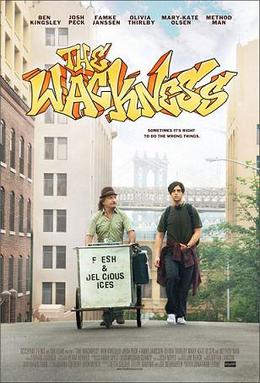
DJG / The Wackness


The Wackness * * *
Directed by: Jonathan Levine / 2008

It's a summer heat wave in 1994 Manhattan. Mix tapes are blastin' the breaking beats of A Tribe Called Quest and newcomer Notorious B.I.G. Graffiti mural tributes to Kurt Cobain are still fresh on the walls. Mayor Rudy Giuliani is cleaning up the storefront prostitution, pornography and drug dealing. Though, he forgot to have his cronies check out a banged-up flavored ices cart missing letter labeled "F ESH & DEL CIOUS", employed by recent high school graduate Luke Shapiro (played well by Josh Peck). He’s not a bad kid, just a little misguided, and mostly on the prowl for one last great New York summer before college and life starts aging. Oh, and Luke wants to spend his last great summer (or at least a weekend) with the girl of his dreams. Instead he spends most of his summer with her step-father.

The treats in the cart aren't for everyone, but given the circumstances, it's better summer profit than selling treats to cool down. Besides, the dough might be needed to keep Luke’s family from being evicted. Even though he’s playing with potential fire, you kinda feel for the kid and want to see him succeed and help see that he gets through his summer of restlessness. For some people Luke’s treats are used to cool down with. In particular, his psychiatrist Dr. Squires (fantastic choice for Ben Kingsley), whom he trades dope for therapy. Quite a deal, like a trick-or-treat, as both have a high street value. But, it's the value of their relationship that is worth more by summer's end. It’s an interesting match to light, an eighteen year-old kid who doesn’t realize he’s on the cusp of life and an aging has-been who wishes to re-hash his glory days.

Normally, I'd be very frustrated with a movie like "The Wackness", and after forty minutes into it, I didn't know if I wanted to keep it on or keep groaning at the characters instead of watching them grow. However, I try to finish movies in hopes for on-screen redemption and development and I think it paid off. "The Wackness" is fresh and delicious at times, even when it seems to be muddling over with the saturated indie cliché market. It’s not perfect, and there are some things that don’t quite do it for me (to mention, a hippy Mary-Kate Olsen…she is still little Michelle Tanner to me!), but something in the lives on screen had me listening and keeping tabs and they felt like they had strings running to reality in some aspects.

As the heat waves are traded for crashing ones on the beach at summer's end, something valuable is found and to be cliché, a changing of the tides roared in. I'm thinking these characters are still breathing…still developing...still unfolding. They’re still out there slicing their own waves and turning tricks and treats in a present New York City aged fourteen years with them.

-djg

CTJ/Miss Pettigrew Lives for Day

Miss Pettigrew Lives for a Day *****

I refuse to clutter up a review of this film with analysis.

Rave rave rave, and then some.

It is charming, entertaining, hilarious, sweet, beautifully human, and above all, magical. I loved this movie.

Sometimes this is all one needs to say.

Tuesday, January 6, 2009

The Curious Case of Benjamin Button ****

So here's the deal. Roger Ebert writes critiques with biases, so I can too. His main beef seems to be that any movie that depicts misogyny in any form is lower than low. He famously hated David Lynch's "Blue Velvet" for this, for example. At the same time, it is obvious that Isabella Rosselini took the leading lady role in that film on her own initiative. People do not tend to star in movies at gunpoint. So if Lynch was indeed unnecessarily cruel to Rosselini's character (Keep in mind, her character, and not her), it is because his script called for it and she rose to the occasion.

My bias with "The Curious Case of Benjamin Button?" I thought the storyline was gimmicky from the get-go, prior to even seeing it. "A guy who ages backwards?" I thought. "Puh-lease." This meant, of course, that I delayed seeing this film because I didn't want to see it. My girlfriend Becki, on the other hand, is a huge F. Scott Fitzgerald fan, and since the film is based on one of his short stories (Note: How did a short story turn into such a long film?) I knew I would be seeing it regardless. Plus, DJG liked it a lot.

That being said, here is my reaction to the film: I didn't like it. But it's not because it's not made well. It is. It is a good film, and I would be hard-pressed to say otherwise. But my biases went deeper and deeper as the film went on. I used to love tragic love stories, and anymore I am tired of them. I am tired of them precisely because I have had too many of them myself, and I cannot help but believe that Cupid need not be stupid. This film did not delve into the stupid Cupid realm of romantic love, but did romanticize tragedy in my book, and I just cannot do that anymore on a personal level. It's like when I was a kid and I ate too many sausage patties at a prayer breakfast I attended with my Dad, and I got sick and developed a taste aversion to them as a result. I could not eat sausage for 10 years after that. I think I have a taste aversion to tragedy when it comes to romantic love. I just cannot suffer it anymore.

Benjamin Button and his soul-mate Daisy "meet in the middle" because she starts off as a girl, and he as an old man who is aging backwards. I realize this is creative stuff, and it is fun and endearing at times as well. I just didn't like it personally. When he and Daisy have a child together he leaves them because he doesn't want his daughter to be his playmate as he becomes progressively younger. He doesn't want to confuse her with this. At the same time, is this really something a child could not handle? I mean, if Daisy can understand the idea of a child in an old man's body, why could her offspring not fathom something similarly strange? Benjamin leaves Daisy and his daughter to protect them from this sort of confusion, and I hated this. Love is messy, and to me this felt like love behind glass -- like that accursed rose in "Beauty and the Beast" and that is under a glass case. It is removed and ultimately unattainable. I just do not see life this way anymore, and seeing the film was like getting a whiff of a worldview gone by, and one that I still have an aversion to. Romanticizing tragedy is not something I can handle anymore. I handled it far too long on a personal level as it is. But that is okay.

As films go, it recalled two that struck me in very divergent ways: "Meet Joe Black," another Pitt starring-vehicle, "Forrest Gump," and "Bicentennial Man." In "Meet Joe Black" and this film, Pitt plays a man who is essentially an observer whose main role appears to be to experience new things in life, to marvel at its wonders, to bear witness to the glory of the beauty of the mundane. There is something truly cinematic about this -- about filming a person's inner experience in some way, and making that the plot. It's very existential, and I like this. But I also think it is a flaw as well, as people are more than observers. They are participants as well, and although Benjamin Button participated in his life in many ways I didn't get the sense of any inner turmoil, of any struggle, of any of the mess that seems to be part and parcel of being human. To me he felt like a man who was watching life happen at a movie theater on the screen in front of him, and somehow his life managed to be a pretty interesting story, so good for him. There is nothing wrong with this, but I just could not identify with that, despite the fact that I often feel like a man who watches life unfold on a movie screen. It's a bit of a paradox, isn't it?

DJG informs me that the same screenwriter who wrote "Forrest Gump" wrote this as well, and it shows. Benjamin Button, like Forrest Gump, is an utterly unique individual who provides the viewer with his own unique insight into life, the world, etc. This works well, but ultimately his life boils down to a series of notable events that, when strewn together, form a chain of pearls on a narrative necklace of sorts. His life is extraordinary, and great care is given to chronicling these events. I talked with Becki about this and, specifically, how we do not experience life this way in first person because we live in what C.S. Lewis called "The waiting room of the world." We have all the lag and drag and ho-hum we need and then some. We do experience life as a series of entertaining fireworks, and perhaps this is why I have a problem with Button's status as an observer who seems content to experience his life in this manner. At the same time, when the Italian neorealist filmmakers decided it would be interesting to film real life, I ended up thinking "I'll take the fireworks instead. Why watch life unfold as it really does when you could do the same without paying the price of admission to a film?"

The "Bicentennial Man" reference came to mind because it is a movie that begs you to "hug the sadness," so to speak. Robin Williams played an emotional android who watched loved ones come and go, and eventually asked for a chip to be implanted that would allow him to die. "Love the squishy sad sadness of the sad, sad, sad story you are watching," it seemed to say. "I don't want to hug your sad sadness," I wanted to say. And I didn't. Same with this film. Its emotional tone and timbre were just not to my liking.

It really is a good film despite the fact that I disliked it so much. It features beautiful cinematography and solid acting. Cate Blanchett, as always, is perfect. And it has much to say about the nature of loss in life and the way we perceive the stream of people who populate our lives and gradually leave them over time. It is worthwhile and necessary for us to learn how to cope with loss, and Benjamin Button learned to cope with it at an early (late?) age when he was an old man/baby and he lived among the elderly in a turn-of-the-century nursing home/townhouse of sorts. He is able to offer unique insight into the nature of loss, and perhaps for this reason he is justified in leaving Daisy and his child because leaving them now is better than leaving them later, at least in his mind. I just couldn't buy it or invest in it emotionally.

Am I glad I saw it? You bet I am! I enjoy going to the movies when I can, and it is rare that I can. So Becki and I went and enjoyed ourselves, and I simply walked away with this trail of brain-crumbs behind me as I left the theater. It wasn't a bad experience. It was just an experience, and it made me aware of how I have changed over the years. I am glad Becki enjoyed it, and I appreciate David Fincher as a director. I just could not empathize with the story in a positive way.

Monday, January 5, 2009

CTJ/The Weekend Watcher

"Crimes and Misdemeanors" ****

DJG has noticed recently that Woody Allen tends to play the same character over and over, and others have noted throughout his directorial history that he simply playing himself repeatedly. Such is the case with his character in "Crimes and Misdemeanors," but not in a bad way necessarily.

There are two parallel narratives in this film that only momentarily converge, and Allen's character is part of the weaker of the two stories that appear here. We have seen and heard his story before, but here it is perhaps a bit more affecting than usual. Here he is the soon-to-be divorcee, the rejected suitor of another, and one whose convictions about his filmmaking and art in general are unswerving and immune to compromise. Well, sort of.

The real sell here is the Martin Landau story, which is as real and tangible and affecting as anything I have ever seen in Hollywood. Caught between a mistress who wants to expose the affair they have been having and his wife of 25 years, he makes a decision that haunts him doggedly. This is where the film puts a microscope to the human condition and makes moral pronouncements and delves into personal responsibility and theology and the nature of reality. It is really pretty profound, and definitely worthwhile.

At the end of the film I found myself wondering exactly what the Woody Allen narrative was trying to say, but only because I was so affected by Martin Landau's portion of the movie. It was so good that it was distracting, and though it may be lopsided for this viewer, it was worthwhile nonetheless.

Just Add Water ****


As I watched this film I could not help but think of Tom DiCillo's excellent, underrated "Box of Moonlight." It has a certain homespun, homegrown quality to it that is awkward but also honest, and it lampoons small-town life, meth-labs, druglords, and culture on the skids. It is an ode to white-trash, and it is a portrait of white-trash turned to gold.


At the beginning of the film I was put off by its flavor, certain that the writing was sub-par, the characters subhuman. But as things progressed I found myself making odd connections with these strange folk, and by the end I was cheering along with them. It's an odd little parable about life at its lowest and the redemption that can follow us into the dark unknowingly. I recommend it highly.


Burn After Reading ****

I had heard enough negative criticism about this film that when I finally saw it Friday with Becki, my girlfriend, I was genuinely surprised by how much I enjoyed it. It may not pack the same sort of existential punch that "No Country for Old Men" did, but I don't think it ever intended to do so. This is the same Coen formula that fueled "The Ladykillers" and "Intolerable Cruelty" -- two films that are considered lesser in the Coen canon, but that are still better than most films made by other aspiring filmmakers.

We watched "Fargo" immediately after this and I was struck by how both films manage to focus on man's capacity to ensnare himself in traps of his own devising. "Burn After Reading," in particular, is circular (as Becki pointed out) in its design, with its characters chasing their tails like dogs that don't really know any better. Unlike dogs, however, they should know better. That's what makes this film ultimately entertaining, absurd, and enjoyable. As humans we live in the Theater of the Absurd, and "Burn After Reading" is a great example of that old line about man being on the stage of life only for a day. He frets and frolicks, and then he is gone and his place remembers him no more. Is it futile? Does it have to be? Maybe there is some food for thought here after all...

Monday, December 29, 2008

DJG / The Dark Knight

The Dark Knight * * *
Directed by: Christopher Nolan / 2008

Even with a Best Picture Oscar in its hands, which I’m still trying to figure out, I never thought I'd see a movie more overrated than 1998's "Shakespeare in Love." But, congratulations are in store for you, Christopher Nolan, you're latest Batman takes my spoiled cake and I secretly hope that you only gobble up a Best Supporting Actor at the big dance.

With my track record on Nolan films and eternal dislike for "Batman Begins", I have been prepping for "Dark Knight" disappointment for about six months to a year now. But, don't get me wrong...I DID try to like this movie. The past couple of weeks I'd finally worked myself up to seeing "The Dark Knight". I knew that it was going to be a cold calculated and hard boiled machine of a movie, and with a so-called legendary performance from Heath Ledger. Though, just when I was starting to warm up to “The Dark Knight”, it failed me. Most importantly, I've come to realize that one shouldn't speak of their lack of love for the new Batman movies in public as everyone and their grandmother are in love with Nolan’s vision and my childhood love is beaten and lost in the heartless debris chunks of a mediocre movie that is close to sinking the box office ice berg that “Titanic” set back in the late ‘90s.

Heath Ledger's lip-licking, make-up smeared, insanely creepy-cool Joker acting genius is the only reason to even give a hoot for "The Dark Knight". Well, I take that back, because I did find great enjoyment in the opening bank robbery and the well-orchestrated truck and motorcycle chase half-way. Maybe because both scenes have solid action and thrills stolen straight out of a Michael Mann heist movie page? Credit is also due to the dark and cold scenic cityscape of Chicago in providing a wonderful asset for swooping shot backdrops. I understand their cooperation for actual special effects and pyrotechnics to be very applauding. Chicago, you've got Gotham in you!

However, all of the things I actually enjoyed and found to be absolutely worth the hype about "The Dark Knight" only accumulate for about 30 minutes of a bloated blah of a Batman that lost my interest less than halfway through. The rest of "The Dark Knight" is a giant melting pot filler of celluloid. Maybe I'm being too critical and harsh? Maybe it's because I think that Christopher Nolan is just as overrated as his movies and I find his films to lack character and plot development. Movies are filler in their own right, but I love them and how in the world am I missing the boat on Nolan and his Batman franchise? I’ve tried so hard to like them, I even did my homework. And Christian Bale’s hot-shot play boy Bruce Wayne is decent at best, but when he puts the cape and cowl on I just can't take Batman seriously. By the end of the film I didn't care if my boyhood hero lived or died, same with the thousands of Gotham citizens and police officers whose lives were on the line. I could have cared less. Am I the heartless one? So, it’s cemented, I don't like this new Batman stuff. I get that Nolan's Batman is all down to cold cutting, brass knuckled business, but give me Tim Burton’s fun operatic and comic book backdrop “Batman” any day.

Now back to the late Heath Ledger. Academy Awards don't define the movies. They don’t define actors. It's all nice, but ultimately nothing but hardware and looks great on paper for future film fans and the cinema archives. However, as Ledger's family accepts a posthumous Oscar in a couple of months, it will be a cemented reminder of one of our finest young actors passing away at the height of his what-might-have-beens and his Joker is the ONLY element that can't be over-hyped enough when talking about "The Dark Knight”.

-djg

Monday, December 22, 2008

DJG's Movie Morning Monday / Man on Wire

Man on Wire * * * * ½
Directed by: James Marsh / 2008

With all due respect to the lives lost, as well as the impact of the tragic event that was the 911 terrorist attacks, one can’t help but be impressed on not only the level of preparation and commitment for devising such a plan, but also actually following thru. However, many men crafting plans to crash planes into buildings, doesn’t hold a mad-genius match to one man walking between them on a wire. “Man on Wire” rewinds nearly thirty years before that black Tuesday in September to a misty day in 1974 when the newborn Twin Towers’ only visible threat in the sky was the determination and passion of a talented French wire walker. After months of thorough planning and commitment Philippe Petit accomplished his dream by doing the unthinkable, crossing between the top of The World Trade Center’s Twin Towers not once, but eight times.

As a youngster, and over a decade after Petit’s death-defying marvel, I remember a certain myth to this hand-me-down tale and responding with a, “Nu-uh…NO way. That didn’t happen!” Back in those days of grade school hear-say and pre-Wickipedia.com (and my lack of library research care) I just couldn’t believe that a human being was crazy enough to do that and especially without a net or licensing agreement with Barnum & Bailey and/or a Spider-Man costume. Pushing thirty I’m now realizing that the people who actually enjoy slaving away their lives inside of tall buildings are the crazy ones. Philippe Petit may be off the rocker, so to speak, but he’s got a unique and mad blazing fire set to his rocker. OK, so it might be crazy to some but even though I cling for dear life to the banister when I climb to the second story of my home, I still find Petit’s life-on-the-edge story to be extremely inspiring in a Timothy Treadwell live with grizzly bears sort of way. In fact, I’m surprised that Werner Herzog wasn’t right there in ’74 with Petit as the two seem like they’d be right up each other’s mad-genius loving alley.

Sadly, but not shocking, after such a magnificently beautiful and life-time achievement, Petit was hammered by American police and press with cuffs and questions of “Why?” and was even submitted for a full psychiatric exam. Thankfully this quickly passed as his trespassing and disorderly conduct charges were exchanged for community performance service and immediate world-wide fame and recognition. “Man on Wire” shows the insane planning and group effort it took for Petit to cross his dream between the towers by way of interviews, archival footage and startling re-creations. It not only celebrates a one-of-a-kind achievement and living talent, but also pays tribute to the once great World Trade Center skyscrapers, resurrecting their strong-hold that stood, and still stand symbolically, for many a dream and life.

-djg